

Linear Search vs Binary Search: Key Differences Explained
🔍 Compare linear and binary search algorithms with clear insights on how they work, their strengths, and when to use each for efficient searching.
Edited By
Amelia Watson
Binary search is a straightforward yet powerful method to quickly find a specific value in a sorted list. Unlike a linear search that scans elements one by one, binary search cuts the search area in half each time, making it much faster especially for large datasets.
Imagine you have a sorted list of stock prices over a year, and you want to find the day when a particular price was recorded. Instead of checking each day’s price, binary search lets you jump directly to the middle, narrowing down where that price could be efficiently.

The key concept is to repeatedly divide the search interval in half. If the middle element is the target, the search ends. If the target is smaller, you focus on the left half; if larger, on the right half. This halving continues until the target is found or the search interval is empty.
This approach runs in logarithmic time, O(log n), compared to the linear approach’s O(n), which is significant when working with sizeable sorted arrays — like market data or large financial records.
Using binary search can drastically reduce response times in applications needing frequent lookups, such as stock trading algorithms or real-time analytics.
Here are some points to keep in mind:
The array must be sorted for binary search to work correctly.
Binary search works well for static data or scenarios where sorting happens beforehand.
It suits use cases like searching transaction logs, historical prices, or client databases.
In upcoming sections, we will cover how to implement binary search step-by-step, explore its variations like searching in rotated arrays, and discuss when this technique might not be the best choice.
Understanding this method will help professionals dealing with finance data, software developers, and students tackling algorithm challenges, improving both speed and accuracy in data retrieval.
Binary search is a cornerstone algorithm when it comes to searching in computer science, especially if the data set is sorted. Getting a grip on these basic principles helps you harness its speed and efficiency effectively. The method narrows the search area swiftly, rather than checking each element one by one, which saves both time and computing resources.
Binary search is a method used to find a target value within a sorted array by repeatedly dividing the search interval in half. Rather than scanning sequentially from the start, it compares the target with the middle element; the search continues on the half where the target must lie. For instance, if you’re looking for the number 25 in a sorted list from 1 to 50, you start at the middle (25). Since it matches, the search ends immediately.
This approach drastically reduces the number of comparisons required, operating efficiently even when handling large datasets common in financial trading platforms or big databases.
The prerequisite for binary search is sorted data. Without sorted data, the method cannot eliminate halves confidently because the order provides the direction to proceed. Imagine trying to find a record in a chaotic ledger without any order — binary search won’t work effectively.
For investors tracking historical stock prices stored in ascending order, binary search quickly pinpoints specific price points, unlike linear search, which could scan through each entry and consume unnecessary time.
Binary search starts with two pointers: one at the beginning (low) and one at the end (high) of the array. It calculates the middle index between these pointers and compares the target value with the middle element.
If they’re not the same, based on whether the target is larger or smaller, it drops one half of the search space, adjusting either the low or high pointer accordingly. This division repeats until the target is found or the search space is empty. Consider searching for ₹1,200 in a sorted price list; binary search halves the list each time, rapidly narrowing down where ₹1,200 could be.
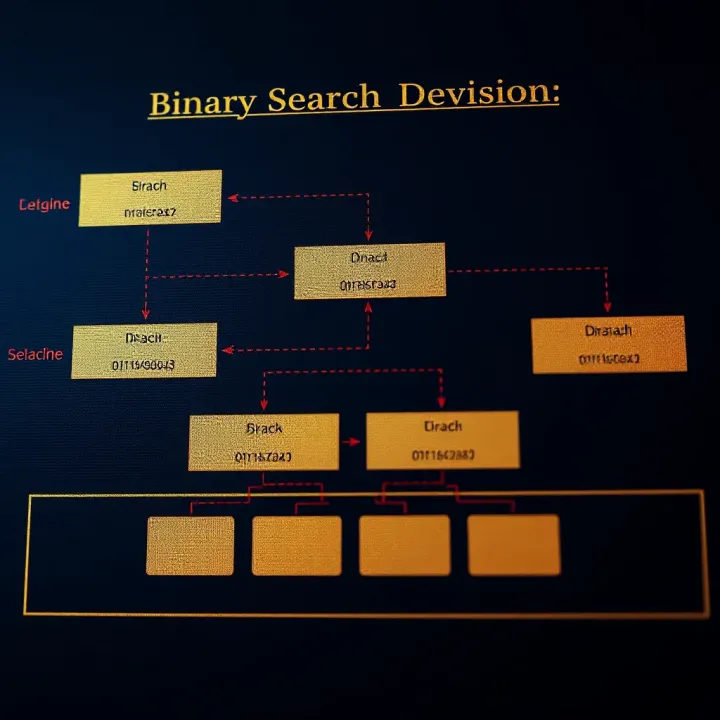
At each step, binary search performs a single comparison between the target and the middle element. Depending on the comparison:
If the target equals the middle element, the search ends successfully.
If the target is less, the algorithm discards the upper half.
If the target is greater, it discards the lower half.
By eliminating half the data in each iteration, binary search achieves O(log n) time complexity, much faster than linear search’s O(n), crucial for real-time applications like online trading systems or stock market analytics.
Binary search shines when you need to find data quickly in a sorted collection, especially under time constraints typical in trading or financial analysis. Grasping these basics enables you to implement the technique correctly and optimally.
This clear understanding sets the stage for diving into implementation details and practical applications covered in coming sections.
Understanding how to implement binary search step-by-step is crucial for anyone working with sorted data. Whether you are coding an algorithm yourself or analysing one, knowing each stage helps in optimisation and troubleshooting. This section covers two common ways to put binary search into practice: the iterative and recursive methods.
Initialising pointers: The very first step in iterative binary search involves setting two pointers—usually called low and high. These pointers mark the start and end indices of the array segment you are searching within. For example, if you have an array of 10 elements, low starts at 0, and high is set to 9. Proper initialisation helps avoid off-by-one errors and ensures the search covers the entire sorted array.
Loop and conditions: The core of the iterative approach lies in looping as long as low is less than or equal to high. Within this loop, you calculate the middle index, compare the middle element with the target value, and then adjust pointers accordingly. If the middle element matches the search key, you return the index. Otherwise, if the target is smaller, you shift high to mid - 1; if it’s larger, you shift low to mid + 1. This controlled narrowing down effectively halves the search space each cycle.
Returning the search result: If the loop ends without a match, it implies the element isn’t in the array. Returning a specific value like -1 indicates this clearly. This is important in real-world applications where finding the absence of an element can influence program flow or trigger alternative actions.
Base case in recursion: Every recursive binary search call must have a clear base case. Typically, this happens when low exceeds high, signalling that the target isn't found in the current search segment. This condition stops further recursive calls and returns an indicator such as -1. Defining the base case correctly prevents infinite recursion, which can crash your program.
Recursive calls and dividing array: If the base case isn’t met, the algorithm calculates the middle index and compares the middle element with the search key. Depending on the comparison, it recursively calls itself on either the left half (low to mid - 1) or right half (mid + 1 to high) of the array. This approach uses the call stack to manage search segments, replicating the halving logic seen in the iterative method.
Advantages and drawbacks of recursion: Recursion often creates cleaner, more readable code because it naturally expresses divide-and-conquer logic. However, each recursive call adds overhead to the system stack, which can be risky for very large arrays or limited stack environments. Iterative methods tend to be more memory-efficient and may run faster. Choosing between iterative and recursive binary search depends on context: recursion suits clarity and simplicity, while iteration favours performance and resource management.
Understanding both iterative and recursive implementations equips you to handle different programming scenarios and optimises binary search use in your code.
In financial data analysis or competitive exam preparations, mastering these methods helps you search large datasets or question banks swiftly and accurately. For instance, locating a specific stock price in a sorted price list or finding a question in an aptitude test database can be much faster with a well-crafted binary search method.
Understanding the strengths and restrictions of binary search helps in applying it effectively in real-world problems. This section explains when binary search shines and where it might fall short, especially compared to other searching methods.
Binary search operates with a time complexity of O(log n), where n is the number of elements in the sorted array. This logarithmic growth means even if the data set grows to a million elements, binary search needs roughly 20 comparisons at most to find the target, which is very efficient. This efficiency becomes especially noticeable in large-scale data applications, like searching within stock market data or databases.
In contrast, linear search checks each element one by one, resulting in O(n) time complexity. For small or unsorted arrays, linear search might still be practical, but as data scales up, it quickly becomes sluggish. For example, scanning a list of 1 lakh entries one by one would be time-consuming, wasting resources that binary search conserves. Thus, binary search saves valuable compute time when applied to sorted datasets.
Binary search requires the data to be sorted beforehand. Without sorting, binary search loses its advantage since it depends on comparing the middle element to narrow the search space. Sorting itself can add upfront overhead—like sorting a transaction history before searching entries—but the fast search that follows usually offsets this initial cost.
Handling duplicates and edge cases demands careful strategy. For example, if an array contains repeated values and you need the first or last occurrence, a standard binary search needs tweaking. Modifications to the binary search algorithm help locate boundaries precisely. Also, edge cases, such as empty arrays or searches for values outside the range, must be handled to avoid errors or infinite loops in code.
Binary search delivers fast lookup only if data is sorted and proper safeguards are in place for duplicates and edge conditions.
Binary search plays a vital role in many practical situations where quick data retrieval is essential. Its efficiency in handling sorted data makes it a preferred choice in software engineering and competitive exams alike. Understanding its uses highlights why mastering this technique benefits programmers, students, and professionals dealing with large datasets or time-sensitive decision-making.
Binary search is commonly employed in databases and array-based data structures. When information is organised in sorted form, searching with binary search slashes the number of comparisons significantly compared to scanning entries one by one. For example, if a fintech app manages transactions sorted by date, locating a particular transaction swiftly becomes much easier using binary search, improving the app's responsiveness.
Moreover, binary search underpins several core algorithms beyond simple searching. Sorting algorithms like binary insertion sort rely on it to place elements efficiently, while more complex data structures such as balanced trees use similar principles to keep operations timely. In coding interviews and real-world projects, binary search often turns up as a utility method embedded in larger systems, proving its broad applicability.
Reasoning and aptitude tests frequently include problems requiring a clear grasp of binary search. These tests assess candidates' ability to think logically and apply efficient problem-solving methods. For instance, reasoning questions may ask about peak element locations or qualifying ranges, all solvable through binary search logic, testing candidates' speed and accuracy.
Competitive exams like the Joint Entrance Examination (JEE) and the Union Public Service Commission (UPSC) also incorporate binary search-related questions. The JEE often includes questions on searching algorithms as part of its computer science syllabus, while UPSC's general studies papers may touch upon logical reasoning aspects covered by binary search principles. Practising these applications helps aspirants sharpen their analytical skills while preparing for these high-stakes tests.
Mastering binary search isn’t just about coding; it enhances problem-solving skills essential across software development and competitive exams.
By integrating binary search knowledge into your toolkit, you can tackle software challenges more efficiently and boost performance in exams that value logical reasoning and precise calculation.
Binary search is more than just a basic search technique; its variants and tweaks help adapt it to real-world situations. These variations focus on key challenges like finding exact positions in sorted data and handling data sets with uncertain sizes. Applying these optimisations can make the search process more precise and efficient, especially in large-scale or dynamic data.
Finding first or last occurrence of an element is a common task when the data contains duplicates. Instead of stopping as soon as an element is found, the search continues in a specific half of the array. For example, to find the first occurrence, after finding a match, the search continues to the left side (lower indexes) to check if an earlier instance exists. This ensures the exact position of the first or last matching element is identified rather than just any occurrence.
This variation proves valuable in applications like stock prices, where multiple records of the same price appear. Locating the first time a price hits a certain level can help analysts understand market trends and trading patterns. The search method is adjusted with minor code changes but offers significant practical benefits.
Range search techniques with examples go one step further. Suppose you want to find all elements within a certain range in a sorted list—say, all stock prices between ₹1,000 and ₹1,500. Binary search can be used twice: first to find the lowest position where values exceed ₹1,000, and second to find the highest position where values are below ₹1,500. The results together provide the exact segment of data within that price range.
This approach applies to scenarios like filtering products by price range on e-commerce platforms or selecting students scored between certain marks in exams. It saves time by avoiding scanning the entire data set, which could be huge in databases or large arrays.
Modified binary search strategies come into play when dealing with arrays where the size is unknown or effectively infinite. Since the end index isn’t known, normal binary search is infeasible as it relies on defined boundaries. Instead, the search starts with a small range (like 1 element), then progressively doubles the range until the target falls within this window. Once the range is established, a standard binary search runs within it.
This technique is commonly used in applications involving data streams, search engines, or large logs where the total number of entries isn’t fixed. It helps avoid unnecessary memory consumption and keeps the search fast even without knowing array bounds upfront.
Practical coding tips for these scenarios include carefully handling index boundaries and preventing integer overflows during doubling steps. Avoid blindly doubling the end index without checks, as it may overshoot the array size or cause errors. In languages like Java or C++, using 64-bit integers for index calculations helps prevent such issues.
Testing on edge cases also matters—for instance, arrays with all identical elements or very large sizes. Writing clear, modular code with comments improves maintainability and reduces bugs in these nuanced versions of binary search.
Using these variations and optimisations effectively can significantly improve search performance and applicability, especially in finance, data analysis, and tech fields where datasets vary widely in size and structure.
🔍 Compare linear and binary search algorithms with clear insights on how they work, their strengths, and when to use each for efficient searching.

Compare linear and binary search in computer science 🔍 Understand their working, pros, cons, and when to pick each based on data size and setup 📊

Explore how linear search and binary search algorithms work, their pros and cons, and when to use each effectively 📚💻 for better coding outcomes.
🔍 Explore the optimal binary search technique, its advantages over standard search, key algorithm improvements, and practical uses in software development.
Based on 12 reviews