
Understanding the Optimal Binary Search Tree Algorithm
Learn how the Optimal Binary Search Tree (OBST) algorithm enhances search efficiency 🌳. Explore dynamic programming, complexity insights, and practical tips!
Edited By
Benjamin Foster
In computer science, understanding the depth of a binary tree is key to grasping how data structures operate efficiently. The depth essentially measures the longest path from the root node down to a leaf node — it tells you how 'tall' the tree is. In practical terms, the depth influences how fast or slow certain operations like searching, inserting, or deleting data will perform.
Think of a binary tree as a family tree — the root represents the oldest generation, and each level down corresponds to children, grandchildren, and so on. The depth is the count of generations you would need to climb down to reach the furthest descendant.
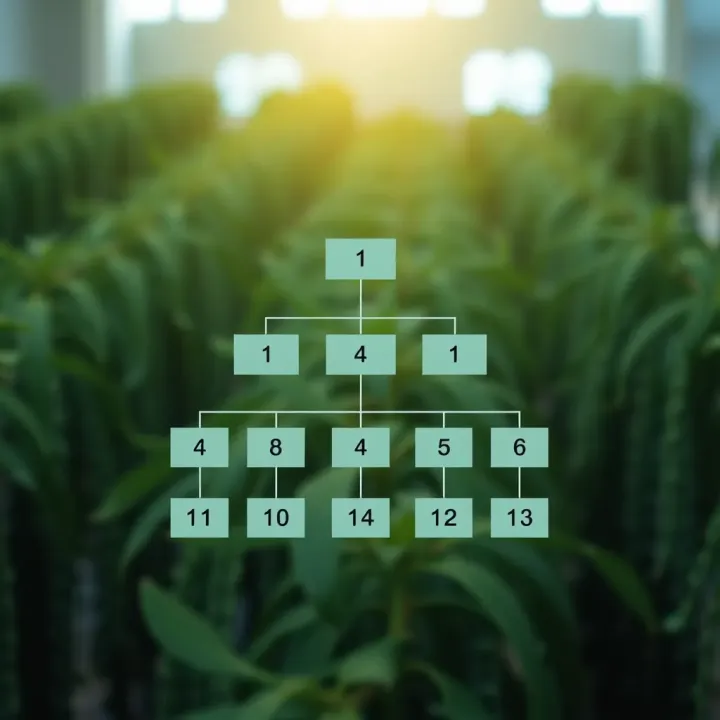
The depth of a binary tree is a direct factor in determining the complexity of many tree-related algorithms.
A shallow tree, with a small depth, usually means faster access times since fewer steps are required to reach any node. Meanwhile, a very deep tree might cause inefficiencies, especially if it becomes unbalanced — some branches extending far longer than others.
Here’s a quick example: imagine a binary tree representing stock price movements for 10 trading days. A depth of 4 means it takes at most 4 steps to reach a particular day's movement from the initial root state, helping algorithms quickly pinpoint trends or check specific patterns.
Understanding this depth helps investors or traders optimise data handling, enabling faster decision-making based on real-time analysis.
In the following sections, we will outline methods to calculate binary tree depth, compare various approaches, and explore practical applications both in finance and computer programming. This foundation makes it easier to appreciate why binary tree depth is more than just a number — it's a core aspect of efficient data organisation and retrieval.
A binary tree is a fundamental data structure that plays a significant role in computer science, especially in areas like searching, sorting, and database indexing. Getting a clear idea of what constitutes a binary tree and understanding how depth fits into the picture helps in optimising algorithms and improving system performance.
A binary tree is a hierarchical structure composed of nodes, where each node has at most two children, typically called the left and right child. The very top node is known as the root, from which all other nodes branch out. For instance, in a banking application, a binary tree could represent decision points for loan approval, where each node splits into sub-nodes based on certain criteria. The simplicity of two children per node keeps the structure manageable, enabling efficient traversals and operations.
Depth in a binary tree refers to the number of edges from the root node down to a specific node. In other words, it tells you how far a node is located from the root. For example, the root has zero depth, its immediate children have a depth of one, and so on. This measure is essential when you want to understand how “deep” your data lies in the structure, which affects traversal speed and access efficiency. In practical terms, if a trader’s decision tree is deep, it may take more steps to reach key decisions, possibly slowing down response time.
These three terms often cause confusion but serve distinct purposes:
Depth: Distance from the root to a node. For example, a node two edges away from the root has depth two.
Height: The longest path from a node down to its furthest leaf. The height of a leaf node is zero as it has no children.
Level: Sometimes interchangeable with depth, indicating a node’s position vertically from the root, starting at level zero.
To clarify, consider a binary tree used in compiler design: depth helps identify how nested a particular syntax element is, height indicates the complexity beneath a certain operation, and level shows its position relative to the root statement.
Understanding these distinctions helps you optimise tasks like balancing trees or designing efficient traversals, directly impacting software performance and resource use.
In summary, grasping the basics of binary trees and clarifying terms like depth, height, and level lay a strong foundation for tackling more advanced concepts like calculating depth and its practical applications.
Calculating the depth of a binary tree is a fundamental task that impacts how efficiently you can manage and traverse data structures. Whether you are analysing stock market data or working on hierarchical business models, knowing the tree depth aids in optimising operations and reducing computational delays. Various methods cater to different scenarios, from simple recursion to iterative solutions using queues and depth-first search (DFS). Each has distinct advantages and practical use cases.

The recursive method is straightforward and elegant. It works by exploring each branch of the tree, calculating the depth from the leaf nodes upwards. For instance, this method checks the depth of the left and right subtrees of a node and returns the maximum of the two plus one (to account for the current node). This approach fits naturally with the binary tree's structure but can cause stack overflow in cases of very deep trees. In real-life coding, this method is popular in interview settings and small to medium data sets because it maps the problem intuitively.
Using a queue for an iterative approach is practical when you want to avoid recursion’s overhead. It leverages level-order traversal (breadth-first search), processing nodes level by level. This method inserts nodes into a queue and counts each level till the queue empties. It’s especially useful in environments where function call stack limitations concern you, such as embedded systems or large data sets common in financial modelling. Although slightly more complex to implement than recursion, it offers better control over memory usage.
DFS explores nodes as deeply as possible before backtracking, lending itself to another way to find tree depth. This approach can use an explicit stack instead of recursion to simulate call stack behaviour, helping prevent stack overflow. DFS is advantageous when you want to examine specific paths or prune the tree early, common in algorithms used for parsing expressions or decision trees in trading strategies. It allows customised traversal orders, which can optimise certain operations that depend on path lengths.
Each method for calculating binary tree depth serves a specific need — from simplicity with recursion to iterative management with queues or the path-focused depth-first search. Choose based on your application size, system constraints, and performance requirements.
To summarise, understanding how to calculate binary tree depth through these approaches equips you with essential tools for working confidently with data structures in varied practical fields, including data analytics, software development, and financial algorithm design.
The depth of a binary tree significantly influences how efficiently operations like search, insertion, and traversal are performed. A deeper tree generally means more steps to reach a node, slowing down these operations. Keeping the depth in check is vital, especially in large datasets where speed matters. Consider a scenario with a binary search tree storing stock prices; if the tree grows unevenly deep, it might take longer to find a specific price, impacting real-time trading decisions.
Search and traversal depend heavily on the tree's depth. When the depth increases, the number of comparisons rises, leading to slower performance. For example, a shallow tree with depth 3 might require at most 3 comparisons to find a value, while a deep tree with depth 10 could take up to 10 comparisons. In financial applications, this delay can matter during high-frequency trades where milliseconds count.
Traversal methods like in-order, pre-order, or post-order also face impacts. A balanced and shallow tree allows faster traversal, essential when analysing hierarchical data such as portfolio structures or risk assessment trees.
Balanced trees aim to keep depth close to the minimum possible, preventing skewed structures that degrade performance. By regularly rearranging their nodes, these trees maintain a height proportional to log(n), where n is the number of nodes. This control over depth ensures consistent operation times, making data access predictable and efficient. Balanced trees find practical use in databases and search engines where quick access to data matters.
AVL trees maintain strict balance by ensuring the height difference between left and right subtrees is never more than one. They perform rotations after insertions or deletions to restore balance, keeping operations like search and update fast. This property suits financial software managing frequent transactions that must remain efficient.
Red-Black trees allow slightly looser balancing by colouring nodes red or black, applying colour rules after changes to maintain balance. Their less rigid structure reduces adjustment overhead, making them ideal for systems requiring a mix of speed and flexibility, such as real-time market data handling.
Balanced trees, like AVL and Red-Black, ensure that binary trees do not become inefficient with depth growth, thus preserving fast search and update operations crucial in time-sensitive applications.
In summary, controlling binary tree depth through balance improves performance and reliability in operations, a factor that cannot be overlooked in data-intensive sectors like finance and analytics.
Understanding binary tree depth becomes far clearer when you apply the concepts to real coding tasks. Practical examples bridge the gap between theory and use, allowing you to see how depth influences tree operations like insertion, deletion, and traversal. Coding implementations, in particular, demonstrate calculation methods in action, making abstract ideas concrete. This section focuses on showing how simple yet effective code snippets in commonly used languages like Python, Java, and C++ can help you grasp depth calculation efficiently.
Python's simplicity and expressive syntax make it ideal for demonstrating binary tree depth calculation. Using recursive functions, Python enables an elegant, easy-to-read approach that mirrors the natural definition of depth: the longest path from the root to a leaf node. This approach not only aids beginners but also suits rapid prototyping in professional data manipulation and algorithm testing. Developers commonly use Python's recursive depth function to quickly evaluate tree properties in data science and machine learning projects.
Java offers a robust, object-oriented framework for implementing binary trees, making it popular in enterprise applications. Implementing depth calculation using Java entails defining node classes and recursive or iterative methods within these classes. Java’s strong typing and memory management help maintain clarity while scaling tree operations in complex software like trading platforms or database indexing. By using Java, programmers ensure type safety and efficiency, benefiting large-scale projects where depth affects performance critically.
C++ provides precise control over memory and performance, valuable for applications demanding high speed, such as real-time data analysis or financial modelling. Its ability to manipulate pointers directly means binary trees can be implemented at a low-level, allowing for optimised depth calculation through recursion or iterative loops. While slightly more complex than Python or Java, C++ code is preferred when performance and resource control are paramount, offering flexibility that suits intensive computational tasks.
Let’s consider a simple binary tree to understand depth calculation practically:
Root node: 10
Left child: 5
Right child: 15
Left child of 5: 3
Right child of 5: 7
Right child of 15: 18
The depth here is the length of the longest path from the root to any leaf node. Starting at 10, we can trace paths:
10 -> 5 -> 3 (depth 3)
10 -> 5 -> 7 (depth 3)
10 -> 15 -> 18 (depth 3)
All paths measure up to depth 3, so the tree’s depth is 3. Coding functions would recursively arrive at this conclusion by checking each subtree’s depth and returning the maximum value plus one for the root.
Practical coding exercises like this sharpen your understanding of binary tree depth and prepare you for more advanced operations, such as balancing or optimising search, essential in sectors like finance and data analytics.
This hands-on focus ensures you don't just know what depth means, but how it directly impacts programming tasks and real-world problem solving.
Understanding the depth of a binary tree has practical consequences across various fields, especially in computing and data management. The depth affects how efficiently tasks like searching, sorting, and organising data are performed. Below, we explore key real-world applications where binary tree depth plays an important role.
Database systems often rely on tree-based indexes to speed up data retrieval. A deeper binary tree means more levels to traverse, making searches slower, so optimising depth becomes essential. For instance, B-trees and their variants keep the depth minimal to ensure fast lookups even when databases hold millions of records. Proper management of tree depth enhances query performance and reduces input/output operations on permanent storage, which is crucial for large-scale systems like banking databases and e-commerce platforms.
A shallow binary index tree means quicker data access, saving both time and computing resources, ultimately improving user experience.
Binary trees help model hierarchical relationships in network routing. The depth of such trees influences the speed and efficiency of routing decisions. For example, in IP routing tables, a shallower tree represents fewer hops, reducing latency. Similarly, file systems on computers and mobiles use hierarchical tree structures where depth indicates folder nesting. Excessive depth can slow down path resolution or permission checks, so designers aim to balance depth against organisational clarity to keep systems responsive.
In compiler design, abstract syntax trees (ASTs) are widely used to represent program structures. The depth of these trees corresponds to the complexity of expressions and nested control flows in the source code. A deeper AST means more recursion during parsing and evaluation, affecting compilation speed. Understanding tree depth helps compiler developers optimise parsing algorithms and manage memory effectively. For example, expression trees for arithmetic calculations use binary trees where depth directly influences the order and speed of computations.
In summary, the depth of binary trees is not just a theoretical concept but a practical factor shaping system performance across domains. Being aware of how depth impacts these real-life scenarios aids professionals and students alike in designing efficient algorithms and systems.
This knowledge helps traders running real-time analytics, finance analysts managing vast datasets, and students learning data structures to better appreciate why tree depth matters beyond textbooks.
Learn how the Optimal Binary Search Tree (OBST) algorithm enhances search efficiency 🌳. Explore dynamic programming, complexity insights, and practical tips!
🌳 Learn what maximum depth of a binary tree means, how to calculate it with recursive & iterative methods, and explore real-world uses and tips.
Explore the maximum depth of a binary tree 🌳—what it means, why it matters, and how to calculate it using recursive and iterative methods for coding tasks.
📚 Understand the concept of maximum depth in a binary tree with step-by-step calculation methods, including recursion & iteration, for all tree types.🌳
Based on 9 reviews