
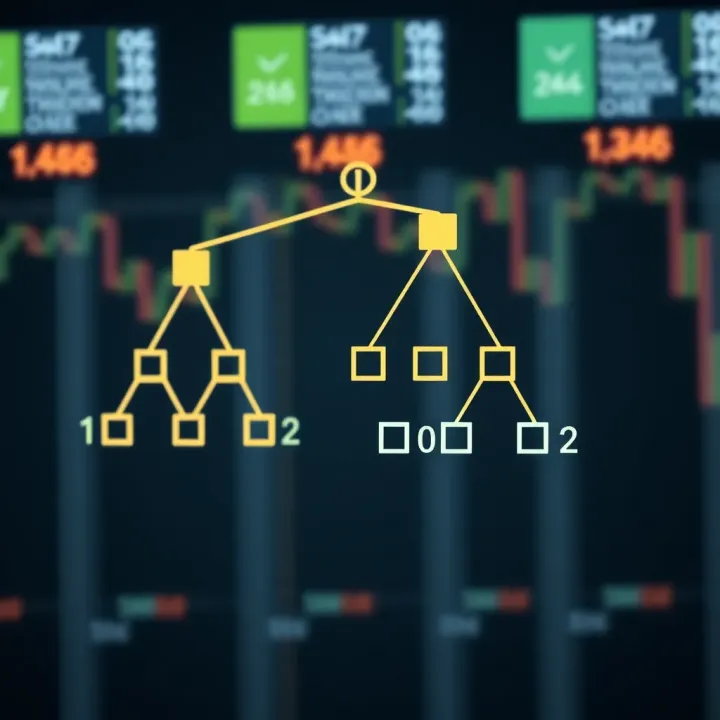
Left Side View of a Binary Tree Explained
🌳 Explore the left side view of a binary tree—key concepts, traversal methods, examples, and algorithms explained clearly for easy understanding and application.
Edited By
Henry Lawson
The left side view of a binary tree shows exactly which nodes are visible when you look at the tree from its left side. Imagine standing at the left edge of a forest of trees—only the leftmost parts of each tree silhouette catch your eye. Similarly, in a binary tree, the left side view lists the first node visible at each level from left to right.

This view is particularly useful in programming and computer science, as it helps understand tree structures, test algorithms, and visualise hierarchical data in a simplified manner. Unlike traversals like in-order or pre-order, which visit every node in a set sequence, the left side view picks only a subset of nodes — those that appear leftmost at a certain depth.

The left side view effectively captures the skeleton of the binary tree's shape, focusing on the nodes that define its visible outline from the left.
To give an example, consider this binary tree:
    10
   /  \
  7    15
 /      \
5        20
Here, the left side view will include 10 (level 0), 7 (level 1), and 5 (level 2). The 15 and 20 nodes remain hidden behind the left nodes from this perspective.

Understanding this concept lays the foundation for several widely-used algorithms in tree programming. It also helps in interviews or coding tests where extracting views of trees is a common problem. As you explore more, you'll see that the left side view is closely related to level-order traversal but restricts output to only the first node seen at every level.

In practical terms, algorithms that generate the left side view often use a breadth-first search (BFS) or modified depth-first search (DFS), ensuring they record the leftmost node at each depth before moving on. This approach reflects an efficient way to glimpse the tree's shape without visiting every node multiple times.

This article will detail the step-by-step methods to obtain the left side view, compare them with other traversal types, and suggest coding practices to implement them effectively in your projects.

## What Is the Left Side View of a Binary Tree

The left side view of a binary tree shows the nodes visible when looking at the tree from its left side. This perspective highlights the leftmost nodes on each level of the tree, providing a simplified snapshot that reveals the structure's hierarchical depth and shape. For investors and analysts familiar with data structures, understanding this view helps in visualising and optimising tree-based algorithms, which can be crucial in domains like financial data organisation or real-time decision systems.

### Definition and Concept

#### Visualising the left side perspective
Imagine standing to the left of a binary tree and observing which nodes are directly visible without any blockage. This viewpoint isolates one node per level—the one closest to you on that leftmost edge. Practically, this helps to capture a linear representation of a complex hierarchical tree, offering insights into the tree’s depth and breadth from this unique angle.

This visual angle is especially relevant when you want to quickly summarise tree data or display hierarchical relationships in applications such as organisation charts or decision trees commonly used in financial software.

#### Nodes visible from the left
The nodes that appear in the [left side view](/articles/left-side-view-binary-tree-explained/) are essentially the first nodes encountered at every level when traversing top to bottom, moving left to right. These nodes collectively represent the silhouette of the tree’s left edge.

For example, consider a binary tree where the root node branches into left and right children. Viewing from the left, only the left child of each level is spotted first, even if right children exist. This concept is useful for pruning or filtering operations, where you want to keep only the leading nodes on each level for simpler analysis.

### Difference from Other Tree Views

#### Comparison with right side view
The right side view is the mirror image of the left side view, revealing the rightmost nodes at each level. Both views provide complementary perspectives of the same tree, but focusing on different edges. Using both views together gives a fuller [understanding](/articles/understanding-left-view-binary-tree/) of the tree’s shape.

In practical terms, if you’re dealing with large hierarchical datasets, checking both side views can help detect asymmetries or imbalances, which might influence load balancing in computing or highlight anomalies in network structures.

#### Relation to top and bottom views
Top and bottom views look vertically down or up at the tree, highlighting nodes visible across horizontal layers rather than just the edges. Top view shows nodes first encountered at each horizontal distance when seen from above, and bottom view does similar from below.

This difference matters when spatial positioning is relevant. While left and right views focus on edge nodes, top and bottom views capture how nodes overlap from a vertical standpoint, useful in visualising overlapping dependencies or network traffic flow in real-time systems.

> The left side view offers a straightforward approach to reduce a complex binary tree into an easily interpretable sequence, vital for efficient programming and structural analysis.

- Left side view highlights the first visible node per level from the left
- Right side view captures the opposite edge nodes
- Top and bottom views focus on vertical alignment and overlapping nodes

Understanding these distinctions helps in choosing the right tree representation for tasks such as UI design, data processing, or algorithm optimisation.

## How to Extract the Left Side View

Extracting the left side view of a binary tree helps you visualise or process the tree from the perspective of its leftmost nodes at each level. This is particularly useful when you want a simple representation of the tree structure without getting overwhelmed by all nodes. In practical scenarios, such as displaying hierarchical data or analysing organisational charts, the left side view gives a quick snapshot of the tree’s layout. Understanding how to extract it efficiently also improves your grasp of tree traversal methods.

### Using Level Order Traversal (Breadth-First [Search](/articles/optimal-binary-search-tree-explained/))

**Step-by-step procedure:** Level order traversal visits nodes level by level, starting from the root. To get the left view, you traverse the tree breadth-wise using a queue. First, you enqueue the root. Then, for each level, you process all nodes currently in the queue before moving to the next level. This systematic approach ensures nodes are handled in order of their depth.

**Capturing the first node at each level:** During breadth-first traversal, the very first node you encounter at each level is the one visible from the left side. By recording this node before processing the rest, you capture the left view accurately. For example, in a tree where the first level has only the root, the left view will include the root node. On the second level, it includes the leftmost child, and so on. This method is straightforward and intuitive, especially when dealing with complete or balanced trees.

### Using Depth-First Search (Pre-order Traversal)

**Recursive approach:** Depth-first search (DFS) explores as deep as possible down one branch before backtracking. When using pre-order traversal (visit node, then left child, then right child), you can recursively visit each node while keeping track of the current level. This recursion is simple to implement in code, and it naturally processes left children before right ones, aligning with the left side view's goal.

**Tracking levels to choose nodes:** The key here is to record the first node encountered at each new level during recursion. When your recursive function visits a node, it checks if this level has already been recorded. If not, that node becomes part of the left view. This technique works well even for skewed or unbalanced trees, because it picks out the leftmost node at each depth regardless of the tree’s shape.

> Whether you use level order or depth-first traversal depends on your specific use case and tree structure. Level order traversal offers a clear, level-by-level perspective, while depth-first recursion shines when dealing with more irregular trees. Both methods reliably extract the left side view, helping you understand and visualise complex trees more easily.

## Implementing the Left Side View in Code

Writing code to extract the left side view of a binary tree is where theory meets practice. This step transforms the concept into something usable, enabling you to apply it in software projects, such as data visualisation tools or hierarchical data filters. Implementing it correctly ensures efficiency, clarity, and scalability, especially important when dealing with large trees [common](/articles/lowest-common-ancestor-binary-tree-explained/) in real-world applications.

Understanding which data structures to use lays the foundation. The choice between breadth-first and depth-first approaches often hinges on the problem context and resource limitations. Each method has its own practical benefits and challenges. Next, we’ll dive into the key data structures essential to each traversal method and look at sample implementations in Java and Python that highlight how these concepts translate to real code.

### Key Data Structures Required

#### Queues for breadth-first search

Breadth-first search (BFS) relies heavily on queues to traverse a tree level by level. The queue stores nodes awaiting exploration, ensuring you visit all nodes at one depth before moving deeper. This suits the left side view extraction because the first node encountered on each level from the left should be recorded.

For example, imagine a queue initially holding the root node. You process this node, then enqueue its left child first, followed by the right child. This order guarantees that the leftmost nodes at subsequent levels appear first in the queue. Using a queue simplifies the logic and avoids recursion stack issues common in deep trees.

#### Stacks or recursion for depth-first

Depth-first search (DFS) uses either explicit stacks or recursion, traversing nodes by diving deep into one branch before backtracking. For the left side view, a pre-order traversal (root-left-right) works well since you visit left nodes before their siblings.

Stacks serve as an iterative alternative to recursion, which is useful when system stack limits might be exceeded. Whether recursive or iterative, tracking the current level is critical—only the first node visited at each level should be included in the left view. This approach requires careful management of function calls or stack pushes and pops, but it excels in scenarios where you want quicker access to individual branches instead of level-wise iteration.

### Example Algorithms in Popular Languages

#### Java implementation basics

Java’s strong typing and built-in data structures make it a solid choice for implementing tree algorithms. The `Queue` interface along with `LinkedList` class facilitates BFS easily, while recursion fits naturally with DFS.

A typical Java BFS approach to left side view initializes a queue with the root, then iterates over levels, capturing the first node. Java’s explicit handling of node structures (like a `TreeNode` class) encourages clear, readable code that is easier to debug and maintain in complex projects.

#### Python code explanation

Python favours succinctness and readability, making it popular for algorithm demonstrations and quick prototypes. Using collections like `deque` for queues and simple function recursion allows writing compact, understandable code for the same task.

For example, Python's dynamic typing lets you skip verbose declarations. You can track levels using function parameters in DFS, and list comprehensions and Pythonic loops make BFS implementation clean. This is helpful for students and professionals who want to grasp the concept quickly or embed the logic into larger data processing scripts.

> Implementing the left side view effectively depends on picking the right data structure and language features, matching your project's scale and complexity. Java offers robustness for large applications, while Python suits rapid development or educational purposes.

## Challenges and Optimisations

When working with the left side view of a binary tree, developers often face unique challenges, especially when dealing with trees that are very large or heavily skewed. Understanding these challenges helps in crafting solutions that run efficiently and make the best use of available resources. Optimising the algorithm not only improves performance but also ensures it works well across different scenarios encountered in real-world applications.

### Handling Large or Skewed Trees

**Memory considerations**: Processing large binary trees requires careful attention to memory usage. For example, a skewed tree—where nodes primarily exist on one side—can cause traversal methods like recursive depth-first search (DFS) to consume a lot of stack space, sometimes leading to stack overflow errors. In such cases, iterative methods or tail-recursive techniques are preferable as they limit memory overhead. Moreover, when trees grow to millions of nodes, storing the entire structure in memory may not be feasible, so algorithms need to be designed to work with streaming data or on-the-fly computations.

**Time complexity factors**: The time taken to extract the left side view depends on how the algorithm traverses the tree. A level order traversal (breadth-first search) will have a time complexity of O(n), where 'n' is the number of nodes, because it visits every node once. However, in skewed trees, the traversal might become more costly due to deeper levels increasing the [height](/articles/maximum-height-binary-tree-explained/) of the tree. Moreover, redundant computations or revisiting nodes can slow down the process. Hence, optimising the approach to avoid unnecessary work is key, especially for large datasets where any inefficiency gets amplified.

### Improving Efficiency

**Using iterative methods to reduce stack usage**: Recursion can be elegant but may not be ideal for very deep trees because of stack overflow risks. Iterative methods using explicit data structures like queues or stacks can manage traversal without relying on the call stack. For instance, using a queue for level order traversal helps control memory use explicitly and prevents stack build-up. This approach works well for enterprise-grade applications where stability matters, especially when the tree depth is unpredictable.

**Early pruning to save computation**: In some cases, it's possible to stop traversal early when sufficient information to determine the left side view has been gathered. For example, once the first node at a given level is processed, sibling nodes on that level might not need further inspection for the left side view. Implementing such early pruning reduces the number of nodes visited and speeds up execution. This technique is handy in performance-critical situations, like live data visualisation tools or real-time organisational hierarchy displays, where delays are noticeable and unwanted.

> Tackling challenges with large and skewed trees through smart optimisations makes the extraction of the left side view not just possible but efficient, helping your applications handle complex data structures smoothly.

## Real-world Use Cases of the Left Side View

The left side view of a binary tree isn't just a theoretical concept; it finds practical use in various fields, especially software development and data analysis. Understanding how elements appear from the left helps in simplifying visualisation and processing complex hierarchical data efficiently.

### Visual Representation in User Interfaces

#### Tree diagrams and display optimisation

Many applications rely on tree diagrams to show hierarchical relationships, whether in file explorers or organisational charts. In such cases, the left side view helps optimise the display by highlighting nodes visible from one perspective, which reduces clutter and improves user focus on key elements. For instance, a file manager showing folders on the left can use the left side view to present the primary folders without overwhelming the user with too many sub-levels.

#### Highlighting hierarchy in applications

Hierarchy is vital in many apps, from project management tools to CRM systems. Using the left side view, developers can emphasise the most critical nodes at each level — usually those aligned to the left — to provide a clear sense of priority and structure. This view ensures that users see the root and main branches first, which guides navigation and decision-making. Take a task scheduling app: showing only the left side view of the task tree can help users focus on main projects before diving into sub-tasks.

### Applications in Data Processing

#### Filtering hierarchical data

Processing large hierarchical datasets can be complex. The left side view acts as a filter to extract the most visible or relevant nodes at each level, which simplifies data handling. For example, in XML or JSON parsing, showing only the leftmost elements at various depths can speed up searches or summaries, helping analysts grasp overall structure without being bogged down by every detail.

#### Network and organisational analysis

Organisations and networks often form tree-like patterns, such as reporting structures or communication flows. Studying the left side view can reveal the top-level influencers or managers at each depth in the hierarchy. This is particularly valuable in corporate restructuring or social network analysis, where identifying key players visible early in the chain helps in planning and intervention. For example, an HR system might display the left side view to highlight department heads who oversee broad teams.

> The left side view provides a fresh angle to view hierarchical data, making it easier to design user-friendly interfaces and manage complex datasets effectively.

This perspective is widely used in data visualisation tools and business intelligence platforms to enhance clarity and decision-making.🌳 Explore the left side view of a binary tree—key concepts, traversal methods, examples, and algorithms explained clearly for easy understanding and application.

Explore the left view of binary trees 🌳: learn what it means, how to find it with step-by-step methods, and why it's key in solving real problems.
Learn how the Optimal Binary Search Tree (OBST) algorithm enhances search efficiency 🌳. Explore dynamic programming, complexity insights, and practical tips!
🔍Explore how to find the max height of a binary tree with easy programming tips, real-world examples & learn why height matters for better tree performance! 🌳💻
Based on 7 reviews