
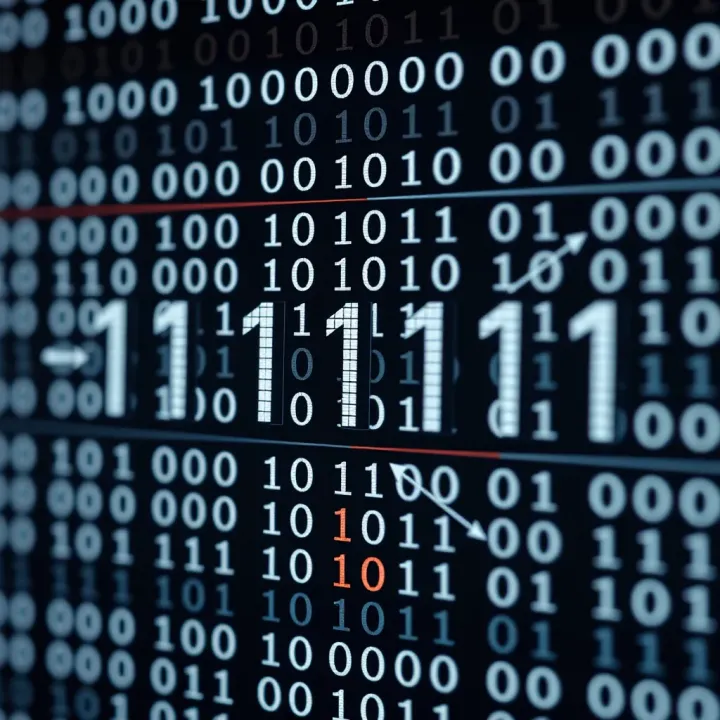
Understanding Binary Code in Computing
Explore binary code's role in computing and digital communication 🔢 Learn how just two symbols power data and modern technology shaping our lives.
Edited By
Thomas Edwards
Binary code language is the foundation of how digital devices communicate and process information. At its core, binary uses just two symbols: 0 and 1. These simple digits represent off and on states in electronic circuits, making all complex computing operations possible.
The concept of binary dates back centuries but found practical application with the rise of modern computers in the 20th century. Its strength lies in simplicity, which helps reduce errors during data transmission and storage. For example, an Indian smartphone stores pictures, audio, and videos as long strings of 0s and 1s, which the device then converts back into formats you see and hear.

Computers translate binary code into meaningful instructions using the processor. Each set of bits (binary digits) can represent text characters, numbers, or commands. This system underpins everything from banking transactions done through UPI to stock market software analysing Sensex trends.
Binary language offers unmatched reliability and efficiency, reasons why it still powers programming languages, data storage devices, and modern communication systems.
Programming: Languages like C and Java depend on binary instructions executed step-by-step.
Data storage: Hard drives and solid-state drives keep billions of bits safe daily.
Digital communication: Signals sent over the internet or mobile networks function via binary encoding.
Modern technology might appear complex on the surface, but at heart, binary code makes it work seamlessly. For investors and analysts, understanding this basic layer can reveal how innovations in computing hardware or software impact operational efficiency and future growth.
In this article, we will explore how binary code works inside digital systems, its evolution, and practical challenges it faces. This knowledge is crucial for professionals who rely on technology-driven insights in finance, trading, or data analytics.
Binary code forms the essential language behind all digital devices and communication systems. Understanding its basics helps decode how computers and other gadgets store, process, and transmit information. This section breaks down what binary code means, how it encodes data, and why it relies on just two symbols. These principles are the foundation of programming, data storage, and digital communication that investors, traders, and analysts encounter daily.
Binary code is a system of representing information using only two symbols — typically 0 and 1. These symbols, also called bits (binary digits), are the simplest way to express data physically or electronically. This simplicity allows computers to use electronic circuits that switch between two voltage levels as the backbone of their operation. For example, a computer stores the instruction to open an application by representing that command as a sequence of bits.
A single bit can represent only two possible values, but combining bits expands its potential. A group of eight bits makes a byte, which can represent 256 different values (from 0 to 255). This byte is the basic unit of information storage in most computer systems. For instance, an image file might use millions of bytes to store millions of pixels' colour information, each pixel encoded in several bytes.
Bits and bytes allow digital electronics to handle complex data efficiently by breaking it down into manageable chunks. This structuring is vital for memory devices, processors, and data transmission protocols, ensuring reliable communication even in high-speed digital trading or online banking platforms.
Binary code also encodes numbers and characters through standard schemes. The most common approach is ASCII (American Standard Code for Information Interchange), where each character, such as a letter or digit, maps to a unique byte value. For example, the letter ‘A’ corresponds to the binary byte 01000001.
Numbers use different encoding methods like unsigned or signed binary, with more advanced forms like two's complement for negative values. This straightforward binary format forms the basis of calculations in software applications, from spreadsheets to algorithm-driven market analysis tools, ensuring precision and speed.
Using only two symbols, 0 and 1, simplifies hardware design and increases reliability. Physical components find it easier to distinguish between two voltage levels rather than multiple states, reducing errors. It's like traffic signals that work best with simple colours — red and green — avoiding confusion. This binary simplicity also saves costs, speeds up processing, and makes error detection more straightforward.
The two-symbol system of binary code, with bits as the unit, enables digital devices to process vast amounts of data reliably, forming the backbone of today’s fast-paced technological world.
This basic simplicity underpins the complex digital infrastructure we rely on, from mobile transactions on UPI to realtime stock trading on NSE platforms. Without grasping these basics, understanding modern digital systems would remain incomplete.
Understanding the history behind binary code sheds light on why it remains fundamental to digital communication today. Before the digital age, binary concepts were explored in various forms that laid the groundwork for modern computing. Tracing this evolution helps us appreciate the logical simplicity and efficiency that binary brought to complex systems.

Binary numbering isn't a modern invention; its roots trace back to ancient civilizations. For instance, Indian Vedic texts, notably the I Ching in China, hinted at dualistic systems resembling binary. In the West, Gottfried Wilhelm Leibniz in the 17th century formally documented binary in a numerical system using 0s and 1s. Leibniz believed binary reflected the universe's basic dualities, such as light and dark or on and off. This idea transformed how information could be encoded, making it easier for machines to process data simply by representing two states.
The real turning point came with George Boole's work in the mid-19th century. He developed Boolean algebra, which deals with binary variables and logic operations such as AND, OR, and NOT. This mathematical framework became the backbone of digital logic circuits. In practice, Boolean algebra lets computers execute decisions and combine simple true/false statements to carry out complex operations. This is why modern programming languages and processor designs rely heavily on Boolean logic—it efficiently governs the way machines interpret binary data.
The first electronic computers of the 1940s embraced binary code for their internal operations. Unlike earlier mechanical calculators that often used decimal systems, machines like the ENIAC and later the EDVAC stored numbers and instructions in binary. This shift was not arbitrary; binary allowed reliable representation of data with on/off electrical signals, reducing errors due to signal noise. Early Indian research institutions such as the Indian Statistical Institute also contributed deeply to understanding computational logic based on binary principles, further cementing its role in computing.
The adoption of binary code simplified the design and manufacture of hardware, paving the way for the rapid advancements in computers and digital communication that followed.
These historical milestones highlight that binary code is no fleeting concept but a carefully honed language that matches the digital world's needs. For investors and professionals tracking technology trends, grasping this evolution clarifies why binary remains relevant and why advancements like Boolean logic still underpin emerging digital systems.
Binary code lies at the heart of all modern computing systems, shaping both hardware and software performance. Its simplicity—using just 0s and 1s—allows devices to execute complex tasks reliably and efficiently. This section explores how binary code integrates with computer hardware and software, highlighting its practical applications.
Logic gates form the building blocks of digital circuits. They process binary inputs (0s and 1s) to produce an output based on logical operations like AND, OR, and NOT. For example, an AND gate outputs 1 only if both inputs are 1; otherwise, it's 0. These gates combine to create circuits that perform arithmetic, comparisons, and decision-making essential for computing. In practical terms, every action your computer takes—be it opening a file or running software—depends on billions of such gates working together inside microprocessors.
Binary code controls how data is stored in memory devices like RAM (Random Access Memory) and SSDs (Solid-State Drives). Each bit represents a tiny switch that can be ON (1) or OFF (0). RAM stores data temporarily for quick access, crucial when running applications or the operating system. SSDs, meanwhile, use binary data to retain information even when the device is powered off. In the Indian context, affordable laptops with efficient memory storage support remote learning and work-from-home situations, showing binary’s real-world impact.
At the lowest level, all software boils down to machine language—binary instructions that a CPU understands directly. Each instruction tells the processor what operation to perform, like moving data or performing arithmetic. Instruction sets like x86 or ARM define the binary patterns corresponding to commands. For instance, the popular ARM architecture drives most smartphones in India, translating app code into binary to run smoothly.
Programming languages like C or Java cannot run directly on a computer; they must be translated into binary through compilers or assemblers. A compiler converts high-level code into machine language, ensuring instructions align with the CPU's binary codes. Assemblers work similarly for low-level assembly language, which is closer to machine language but more readable by humans. This translation process allows developers to write efficient code that hardware can execute, bridging human logic and binary operations.
Binary code acts as the universal language connecting software instructions and hardware mechanisms, making modern computing possible across devices from smartphones to supercomputers.
This foundational role of binary code in both hardware and software underpins India's growing tech landscape—from startups developing AI models to large IT firms building enterprise solutions. Understanding this helps investors and professionals appreciate how fundamental digital communication truly is.
Binary code extends far beyond the confines of traditional computing, forming the backbone of various digital communication systems and everyday technologies. Its simplicity and reliability allow seamless data handling across multiple platforms, making it indispensable for modern digital communication.
Binary in Networking Protocols: Binary code underpins networking protocols, which govern data exchange over the internet and other digital networks. Protocols like TCP/IP and HTTP use binary sequences to represent and transmit packets of information accurately. This binary-driven framework enables devices to communicate efficiently, be it through emails, web browsing, or video calls. In India, for example, the widespread use of broadband and mobile data networks relies on these binary protocols to maintain fast and stable connectivity.
Error Detection and Correction: Binary code also plays a vital role in ensuring data integrity during transmission. Techniques like parity bits, checksums, and cyclic redundancy checks (CRC) use binary sequences to detect and correct errors that occur due to noise or interference in communication channels. Consider banking transactions over the UPI system: these error-correction methods guarantee that sensitive data reaches its destination without corruption, preventing transaction failures or fraud.
Mobile Phones and UPI Transactions: Mobile devices function on layers of binary code to process calls, messages, and applications. Every action on your phone breaks down into binary instructions for hardware and software to execute. Likewise, UPI (Unified Payments Interface) transactions—a popular mode of payment in India—rely on binary communication between smartphones, bank servers, and payment gateways to authenticate users and process payments swiftly and securely. This behind-the-scenes binary code ensures money moves safely and instantly without manual intervention.
Digital Media and Streaming: Streaming platforms like Hotstar, Netflix India, and YouTube convert audio and video files into binary data compressions for efficient storage and transmission. These binary files travel over networks to your device, where software decodes them into smooth playback. The binary format allows large media files to be streamed without buffering interruption, catering to millions of Indian users who consume digital content daily, even on modest internet speeds.
Binary code's versatility makes it fundamental not just for computers but for all digital systems that power our communication, transactions, and entertainment.
By understanding how binary functions beyond computing, including its role in communication protocols and consumer technology, professionals and investors can better appreciate the technology’s pervasive impact on digital infrastructure and market trends.
Binary code has powered digital communication and computing for decades. However, like any system, it comes with its own set of challenges and limitations. Understanding these helps you appreciate why engineers often look for ways to optimise or complement binary-based technologies.
Binary representation can lead to significantly large data sizes, especially for complex information. For instance, storing high-resolution images or videos requires encoding millions of pixels into binary, which consumes substantial storage and bandwidth. This can slow down transmissions or demand expensive memory solutions. That said, techniques like compression algorithms (JPEG for images or MP4 for videos) aim to reduce this bulk but still rely on binary at their core.
Moreover, the simplicity of binary digits—just 0 and 1—means more bits are needed to represent the same information compared with systems using larger base values. For example, decimal numbers need multiple bits to convey their values, which could be more space-efficient in other numeral systems. This trade-off between simplicity and data volume is a key consideration in hardware design and network engineering.
Security risks tied to binary code arise because digital systems process everything as a string of bits. Hackers exploit vulnerabilities at this basic level through methods like buffer overflow attacks or bit-flipping attacks, where altering specific bits can cause software malfunctions or breaches.
Take encryption protocols widely used in banking or financial transactions in India. They employ complex binary algorithms but remain vulnerable if the underlying hardware or software implementations have flaws. Ensuring secure storage and transmission thus requires constant updates and rigorous testing to prevent binary-level exploits.
In addition, since all digital communication ultimately involves binary signals, interception becomes a real threat. Without robust encryption, binary data travelling over networks like UPI or net banking can be compromised. Hence, layered security protocols complement the basic binary structure to make data transmission safe.
Ultimately, recognising the challenges of binary code encourages innovation. Advances in quantum computing and alternative coding schemes like ternary systems are being explored to overcome these constraints. But for now, binary remains fundamental, despite its efficiency and security challenges, and understanding these helps professionals make better decisions in tech and finance domains.
Binary code remains the backbone of digital technology, but it is evolving alongside innovations that promise to reshape computing and communication. Understanding future trends related to binary code helps investors, finance analysts, and professionals anticipate shifts in technology infrastructure and opportunities. This section focuses on two key areas: quantum computing advances and binary's role in emerging technologies.
Quantum computing introduces a radically different way of processing information by using quantum bits or qubits, which differ from traditional binary bits. Unlike binary bits that are either 0 or 1, qubits can exist in multiple states simultaneously, thanks to superposition. However, classical binary code still forms the foundation for interfacing and programming quantum machines today.
The progress in quantum computing technology can complement classical binary systems rather than replace them immediately. For example, hybrid quantum-classical algorithms utilise binary code to manage control instructions while quantum processors handle complex calculations like factorisation and optimisation. This approach holds great potential in areas such as cryptography, material science, and financial modelling, where current binary-based computers face limitations.
Indian startups and research institutions are beginning to explore quantum computing's practical applications. For investors and financial analysts, keeping an eye on funding trends and technology milestones in this sector can indicate future market shifts. The gradual integration of quantum principles with binary computing systems may unlock new capabilities without discarding the legacy technology.
Despite emerging tech frontiers, binary code continues to play a central role in powering innovations across sectors. Technologies such as Artificial Intelligence (AI), Internet of Things (IoT), blockchain, and 5G networks rely heavily on traditional binary encoding for data transmission and processing.
For instance, blockchain systems store transactional data in binary format to ensure security and immutability. Financial institutions using blockchain-based platforms benefit from this stable data structure to execute reliable transactions. Similarly, IoT devices embedded in smart homes, agriculture, or logistics use binary signals for communication and control.
5G technology, expanding rapidly across urban and rural India, depends on binary-coded protocols to manage vast amounts of data with low latency. AI applications, from voice assistants in regional languages to fraud detection in banking, are built on binary-encoded datasets processed through machine learning algorithms.
Emerging technologies may introduce new computing models, but binary code will continue to underpin how data is stored, processed, and transmitted for years to come.
To sum up, while quantum computing opens the door to new paradigms, binary code remains vital within evolving technology landscapes. Recognising binary’s continuing relevance helps stakeholders understand where to invest and how digital infrastructure might develop. By combining classical binary with innovative solutions, the tech ecosystem can achieve greater efficiency and practical impact.
Explore binary code's role in computing and digital communication 🔢 Learn how just two symbols power data and modern technology shaping our lives.

Explore binary language 📊—the base of digital communication and computing. Learn how computers use binary data for everyday tech, its history, benefits, and limits.

📊 Learn how binary numbers work, convert between binary & decimal, and grasp binary math with real-life computer applications in this easy guide.

Learn how to convert binary numbers to hexadecimal with clear steps, practical examples, and key tips for accuracy. Ideal for students and tech enthusiasts 💻🔢
Based on 12 reviews