

Understanding Optimal Binary Search Trees
Explore optimal binary search trees 🌳 in algorithm design and analysis. Learn dynamic programming methods, practical uses & performance tips for efficiency.
Edited By
James Cartwright
Binary search stands out as a highly efficient technique for searching a target value within a sorted list. Its strength lies in the divide and conquer approach, which keeps splitting the search range in half until the target is either found or the list is exhausted. This strategy sharply reduces the number of comparisons compared to linear search, especially for large datasets.
At its core, binary search takes a sorted sequence — for example, a list of stock prices for the past year arranged from lowest to highest — and compares the middle element with the target value. If the target is smaller, it discards the right half; if larger, the left half is ignored. This halving repeats, narrowing down the search space swiftly.

The power of binary search lies in how it uses sorting and division to reduce what would be thousands of comparisons to just a handful, making it particularly useful for financial data, databases, and even search engines.
To illustrate, finding a share price of ₹150 in a sorted list of 1,000 prices requires at most about 10 comparisons (since 2¹⁰ = 1024). Without this method, a simple linear search might need up to 1,000 checks.
This approach does not only speed up searching but also sets the stage for efficient algorithms in various domains, including:
Quick decision-making in stock trading platforms by swiftly locating price points
Data retrieval systems where sorted data structures like indices or metadata exist
Optimising database queries where join and search actions depend on efficient lookups
Understanding the underlying divide and conquer method provides a solid foundation to grasp why binary search is reliable and widely applied. In subsequent sections, we will break down how its recursive and iterative versions function, compare their performance, and explore where each fits best in practical usage.
By mastering this algorithm, investors, traders, analysts, and students alike can appreciate the significant edge binary search offers in handling sorted data efficiently under tight time constraints.
Understanding the basics of binary search is key to appreciating how this algorithm simplifies searching tasks in sorted data. For investors or analysts dealing with large, sorted datasets like stock prices or historical returns, binary search offers a swift method to locate specific entries without scanning each element. It drastically reduces the number of looks required, saving time and computing power.
Binary search is a search technique used on sorted lists or arrays. Instead of checking every entry one by one, it repeatedly divides the search area in half, narrowing down where the target value could be. Imagine you have a financial report sorted by date, and you want to find the data for 10 March 2024. Binary search doesn't start at the first date and check sequentially; it jumps to the middle date, then decides which half to look into next, quickly locating the right record.
For binary search to work correctly, the data must be sorted in ascending or descending order. Applying binary search on an unsorted list leads to incorrect results or misses completely. Additionally, the structure should allow random access, like arrays or lists, where you can directly reach any element by index. For instance, if you have customer transaction records sorted by transaction ID, binary search can assist in quickly retrieving a particular transaction without sorting or full scanning.
The algorithm starts by setting two pointers — one at the start and another at the end of the sorted list. It then calculates the middle position and compares the target value with the middle element. If it matches, the search ends. If the target is smaller, the search continues on the left side; if larger, on the right side. This process repeats, slicing the search space by half each time until the target is found or the search space is empty.
Binary search’s efficiency lies in its halving process, reducing the search area exponentially. For a list of one lakh items, instead of checking all, it only makes about 17 comparisons at most.
In practice, this means faster queries and less CPU usage, especially useful for real-time data analysis or trading software where speed is critical. Understanding these basics sets the foundation to grasp how the divide and conquer approach powers binary search's speed and precision.
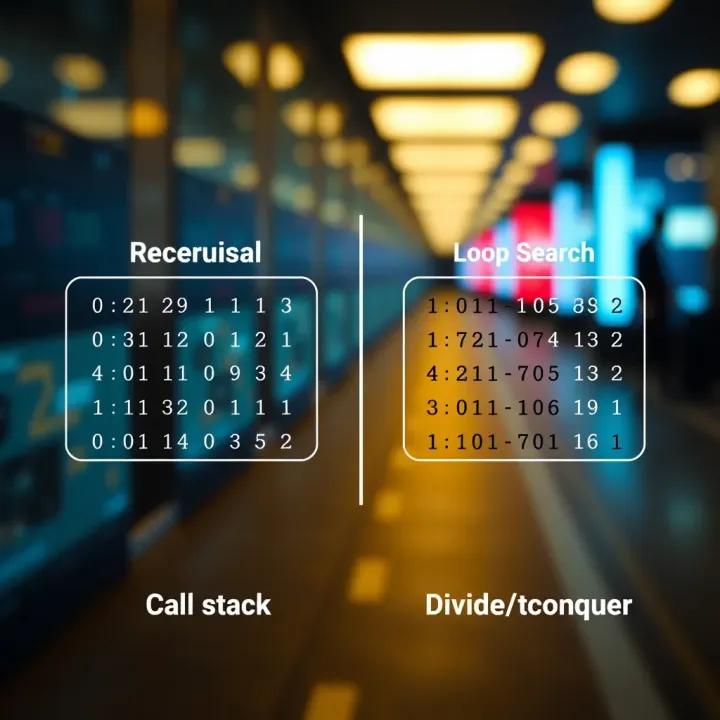
Divide and conquer is a simple yet powerful method used in algorithm design. It works by breaking a complex problem into smaller parts, solving each part separately, and then combining those solutions to solve the original issue. This strategy helps reduce time and effort compared to tackling the problem all at once.
To picture it, think of searching for a book in a huge library. Instead of scanning every shelf, you first divide the library into sections. Then, you focus on the section likely to have the book and repeat the process until you find it. This stepwise reduction saves time and avoids needless searching.
The key elements include:
Divide: Split the problem into smaller subproblems.
Conquer: Solve each subproblem independently.
Combine: Merge the solutions into a final answer.
This approach is particularly effective when the subproblems resemble the original problem but on a smaller scale.
Binary search applies divide and conquer by halving the search area repeatedly. Suppose you want to locate an item in a sorted list of 1,000 stock prices. Instead of scanning all 1,000, binary search starts in the middle, compares the target with that middle item, and discards the half where the target can't be.
This process reduces the searchable range quickly. For example, after one comparison, it cuts down to 500 items, then 250, then 125, and so on, until it lands on the correct price or finds it's not there. This halving approach speeds up the search remarkably compared to linear methods.
In practical terms, this means that searching through a sorted database or price list becomes efficient enough for real-time trading decisions or portfolio analysis. The divide and conquer approach ensures that even with large data sets, the system remains responsive.
Binary search’s success hinges on this divide and conquer methodology — it breaks down a big search into manageable chunks, eliminating half the possibilities at every step.
Understanding this strategy helps investors and analysts appreciate why binary search remains a cornerstone in computer science and finance software solutions. It shows how a systematic breakdown can save both time and computing resources, especially when dealing with large, sorted datasets.
Implementing binary search is essential to grasp how this algorithm efficiently narrows down the search space in a sorted array or list. Practical implementation helps demystify the underlying divide and conquer strategy, making it easier to adapt and optimise the search for different scenarios. For example, you might use binary search in financial software to quickly locate stock prices on a sorted list from a huge dataset, saving time over a linear scan. Also, understanding different ways to implement binary search helps when working within language or system constraints, such as stack limits or performance demands.
The iterative approach employs a simple while-loop to reduce the search space repeatedly until the target is found or the list is exhausted. It uses two pointers — low and high — to represent the current search interval. At each step, the midpoint is calculated, then the target is compared with the middle value to decide which half to continue searching in. This method avoids the overhead of recursive calls, which is especially useful in languages without tail-call optimisation. For instance, in trading applications, iterative binary search can be the preferred method due to its low memory footprint during heavy computation.
Recursive binary search divides the search task into smaller subproblems by calling itself with adjusted boundaries, narrowing down the segment each time. It's a neat and intuitive way to implement the divide and conquer pattern, directly reflecting the algorithm's conceptual design. However, recursive calls can add overhead due to function call stacks, potentially causing stack overflow errors with massive arrays unless tail-call optimisation is available. Programmers might prefer this approach during learning or when clarity of code is more important than absolute speed, such as in academic projects or small utilities.
Both methods eventually achieve the same goal with O(log n) time complexity, but they differ in memory usage and clarity. Iterative binary search generally uses less memory since it doesn't add to the call stack, making it more efficient for large datasets or resource-constrained environments. Recursive code, while elegant and easier to read, risks stack overflow and can be slower due to function call overhead. The choice between them often depends on the context: iterative suits production-grade systems that require resilience and speed, whereas recursive works well for teaching or when simplicity is preferred.
Understanding these implementation nuances allows you to pick the right method for your use case, ensuring binary search is both efficient and maintainable.
By mastering both approaches, you can confidently apply binary search in diverse Indian financial applications, algorithmic trading tools, and educational contexts, sharpening your problem-solving toolkit effectively.
Understanding the performance of binary search is key to appreciating why it is still favoured in many real-world scenarios. Binary search reduces the number of comparisons dramatically by halving the search space with each step, which makes it efficient for large sorted datasets. However, knowing where it fits well and where it doesn't can help you choose the right tool for your coding or analysis work.
Binary search operates with a time complexity of O(log n), where n is the number of elements in the sorted array. This means that if you double the size of your data, the number of comparisons only increases by one. For instance, in a list of one million sorted items, binary search will take roughly 20 comparisons in the worst case, rather than scanning all million elements. This efficiency comes from the divide and conquer strategy, which repeatedly divides the dataset in half, quickly zeroing in on the target value.
The main advantage of binary search is its speed compared to linear search, especially on very large, sorted datasets. It also requires less memory overhead than some complex search algorithms. But this speed depends on the crucial condition that the data set must be sorted; otherwise, the method is ineffective. Also, binary search may not be the best option if the data changes frequently, as it requires maintaining a sorted structure. Moreover, while it works perfectly for simple exact matches, it is less suitable for complex queries or unsorted data without preprocessing.
Binary search finds wide use in financial systems, such as in stock trading platforms analysing large sorted historical prices to find specific values quickly. In software development, functions like searching for a word in a dictionary app or looking up a contact in a phonebook app commonly use binary search. Even outside software, imagine searching for a specific page in a phone directory – flipping through by halving the remaining pages is essentially the same principle.
Efficient data lookup saves both time and computational resources, making binary search a valuable technique for investors and analysts dealing with large data sets routinely.
By understanding these performance factors and contexts, you can apply binary search effectively in your technical tasks, avoiding common pitfalls and maximising efficiency.
Binary search works brilliantly on sorted arrays, but real-world data isn’t always that straightforward. Enhancements and variations of binary search help adapt it to more complex or irregular conditions. These tweaks extend binary search’s utility beyond classical use cases, making it relevant for practical problems where the data might be rotated, contain duplicates, or need integration with other algorithms. Understanding these variations deepens your grasp of the divide and conquer approach and how it fits into broader problem-solving tools.
Imagine a sorted array that’s been rotated at some unknown pivot point, like a list cut and rearranged. For example, an array sorted as [10, 15, 20, 25, 30] might become [25, 30, 10, 15, 20]. Standard binary search fails here because the order is broken. To handle this, an enhanced binary search checks which half is sorted at each step, deciding the direction accordingly.
This variation cleverly identifies which segment of the array retains the sorted property, aiding effective narrowing of the search space despite the rotation. This method is widely used in scenarios like searching in circular buffers or rotated logs in systems, where the data isn’t strictly linear but still largely ordered.
Duplicates can complicate binary search since the presence of repeated values makes it tricky to decide which half to explore next. For example, consider [2, 3, 3, 3, 4, 5]. When the middle element equals the target but duplicates exist, binary search needs to adapt to find the first or last occurrence if required, rather than any occurrence.
One common approach is to modify the comparison logic and continue searching even after finding the target, to determine the exact boundary. This is especially useful in time series or financial data, where one might want to find the earliest or latest occurrence of a price point rather than just knowing it exists.
Binary search's divide and conquer principle appears in various algorithms beyond direct data searching. Quick sort, for example, splits the array around a pivot and recursively sorts the partitions. Merge sort divides the array repeatedly before merging sorted segments.
These algorithms share the pattern of breaking a problem into smaller parts, solving each, and combining results efficiently. Understanding the binary search variations helps in appreciating this recurring strategy in many efficient algorithms used in software, data analysis, and more.
Enhancements of binary search show its flexibility. They not only solve niche problems but also highlight the strength of divide and conquer — breaking down challenges, narrowing focus, and delivering fast, precise outcomes even under tricky conditions.
By mastering these variations, you can handle real-world data complexities methodically, improving the reliability and effectiveness of your search operations.
Explore optimal binary search trees 🌳 in algorithm design and analysis. Learn dynamic programming methods, practical uses & performance tips for efficiency.

🔍 Explore how linear and binary search algorithms work, their efficiency, pros & cons, and when to choose each for better data searching results.
🌳 Explore how the Optimal Binary Search Tree algorithm improves search efficiency by minimizing cost compared to regular BSTs and its role in computing.
🔍 Explore the optimal binary search technique, its advantages over standard search, key algorithm improvements, and practical uses in software development.
Based on 11 reviews